By: Jaimie Patterson
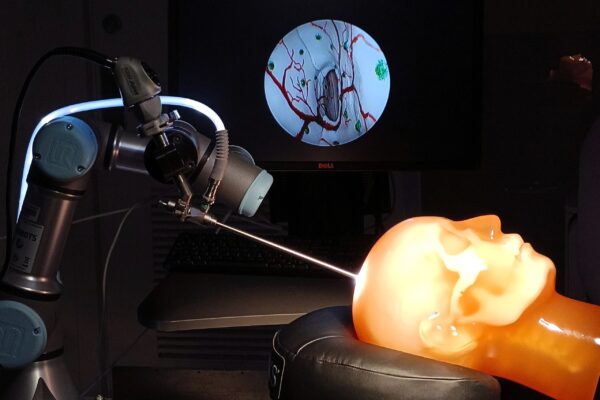
Navigational technology used in self-driving cars aids brain surgery visualization
- August 31, 2023
- Medical Imaging
Johns Hopkins researchers demonstrate the promise of “augmented endoscopy,” a real-time neurosurgical guidance method that uses advanced computer vision techniques.

Muyinatu Bell awarded $1.5 million NIH grant
- August 22, 2023
- Medical Imaging
John C. Malone Associate Professor of Electrical and Computer Engineering Muyinatu A. Lediju Bell has received a four-year, $1.5 million R01 grant from the National Institutes of Health to develop new technology for photoacoustic-guided hysterectomies in an effort to make the procedures safer via informative, real-time feedback.

First cohort of Malone Postdoctoral Fellows announced
- August 21, 2023
- Center News
Tsung-Chi Lin and Deepak Raina have been named as the first recipients of the Malone Postdoctoral Fellowship. The selective program provides postdoctoral researchers with resources to support clinically-facing research, faculty mentorship and collaboration, and the opportunity to play a defined role in the Malone Center's research mission.

Johns Hopkins makes major investment in the power, promise of data science and artificial intelligence
- August 3, 2023
- Center News
A new data science and translation institute will bring together experts from a wide range of disciplines to capitalize on the rapidly emerging potential of data to fuel discovery across the university.

Photoacoustic imaging gets flexible
- July 31, 2023
- Medical Imaging
In an effort to improve real-time surgical visualization and reduce potential patient discomfort and injury, Johns Hopkins researchers have verified the accuracy and applicability of a minimally invasive live medical imaging method in a new study.
Malone faculty win DELTA Award
Their winning proposal will receive up to $75,000 to help innovate learning through technology.